NEW SUNLIGHT ON OLD SHADOW

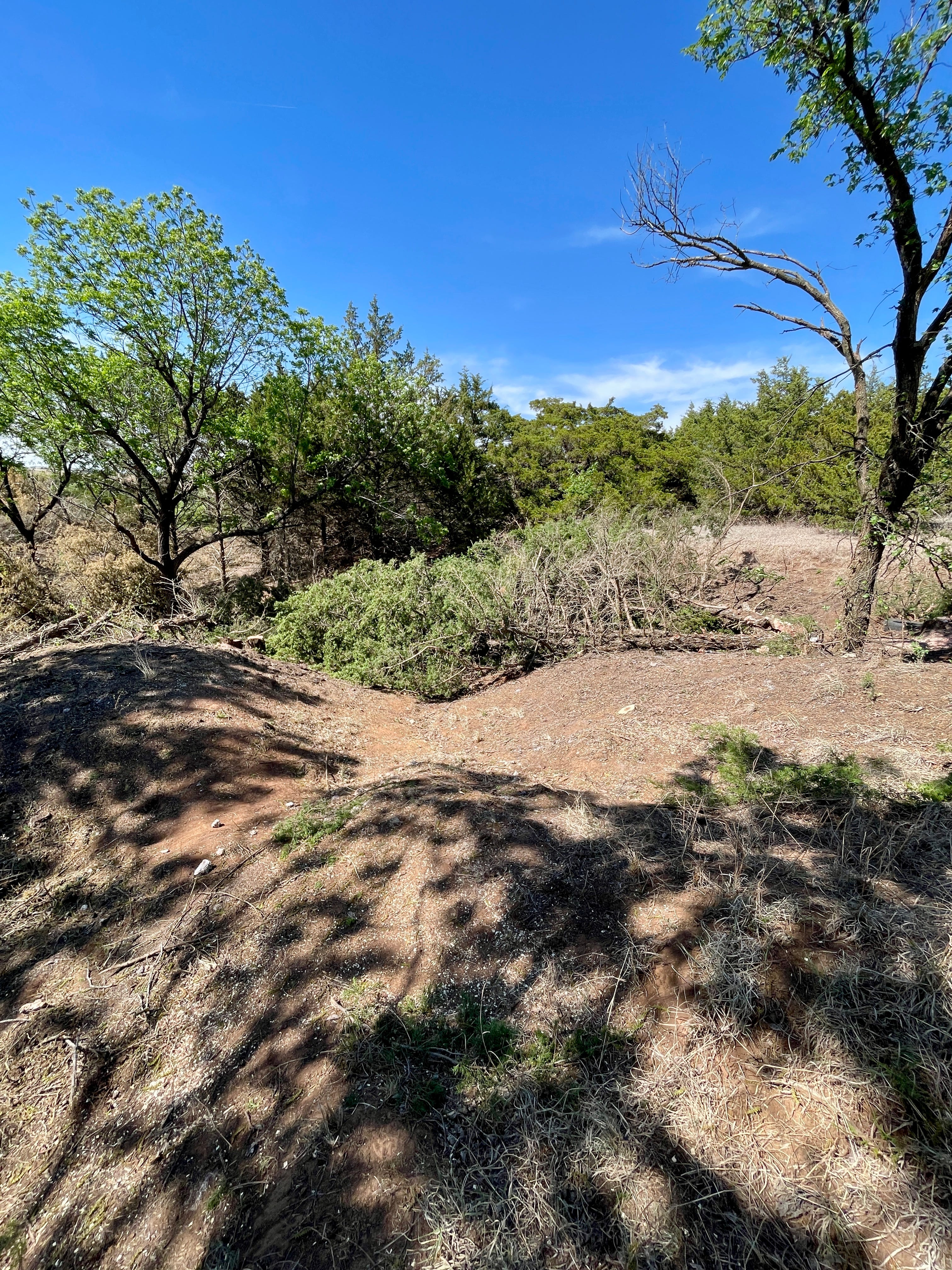
In all things, progress is most often measured in such small increments that you will despair of ever seeing before you what you so easily see in your mind. And such it is with trying to wrestle the land back from the enveloping and fiercely tenacious grip of an invading army.
But keep at it, and progress will give you an occasional, fleeting glimpse of itself; a reminder that while all good things must be earned and earning does not come cheap, that tiny bit of progress you have bought with all that sweat is worth the price.
And for me, there are few things more wondrous and more worthy of the equity than seeing new sunlight hitting ground that has known nothing but perpetual shadow.
For years now I’ve been waging a small, lonely war on this 160-acre piece of southern plains prairie. It is a place I love. Some of my ashes will be scattered here when I die, high on a ridge where as a young man I saw my first lesser prairie chicken, and where I sit sometimes of a summer evening listening to lonely male bobwhites calling from the grass, searching for love.
But this place is also changing, quickly, much like the rest of the southern great plains. That first prairie chicken I saw thirty years ago was the last prairie chicken I ever saw in this country. There are legion threats both obvious and subtle facing the grasslands of the southern plains: climate change, conversion of grassland to farmland, development, overgrazing, aquifer depletion, and of course woody encroachment, which is the issue I have been sweating (both literally and figuratively) lately.
Over the course of decades of fire suppression and a sort of benign mismanagement involving too many cows, a complete absence of fire, combined with a lack of awareness of just how acute the problem had become, this little patch of prairie had slowly gotten choked out by an encroaching wave of eastern redcedars, a native species that historically had been controlled by fire and bison but over the past century has been inexorably spreading across the grasslands.
This ground is just a postage stamp-sized microcosm of what is happening all across the region. Looking across the fence I see mile upon mile of dense cedars, always spreading. The scope of the problem can seem overwhelming, and it often makes me feel futile and silly with my little chainsaw, as if I’m simply engaging in cosplay performance art, and that nothing I do will make the slightest bit of difference on a larger level than the small patch of ground I try to defend.
Which is true, of course. But as I told a friend recently during a conversation on the topic of conservation, I continue to do it because on the individual level, that insignificant performance art is the only tangible, organic thing I have to give me the illusion that something I do matters, if only for a moment (ecologically speaking) and if only on a tiny patch of ground.
It is the solace of individual action, telling myself that in doing what I do on such a microscopically intimate, strategically insignificant level, but on a piece of ground I so dearly love, the action itself will bring me peace and a sense of grounding in a world that otherwise seems so untethered and increasingly unhinged.
And I think a lot of small landowners probably have a similar feeling. I absolutely believe that small-scale conservation is more psychiatry than conservation, a coping mechanism against the ever-looming machinations of the larger world and the sense of utter hopelessness it engenders.
Does it actually accomplish anything beyond that? On some levels, not really. This patch of prairie upon which I labor, where I first saw that first chicken so long ago, will never see another chicken no matter how hard I work my guts out on this place, no matter how many cedars I cut.
And there’s not a damn thing any one program, agency, or conservation group is going to do to change that. Because the will — political, economic, social, policy, and otherwise — to do what needs to be done on a landscape level is simply not there, and never will be there. Political and cultural reality can be a crushing force on that kind of hope and vision.
But not on our individual level. Not on our tiny little spaces where we can make enough of a difference to give us whatever measure of solace we need to keep going.
And so I will keep cutting, and keep looking for those little glimpses of progress and joy and hope that keep me going and give me my own small measure of solace and meaning.
From where I took this photograph you couldn’t crawl — much less see — to the other side of this little side finger off the main draw that I’ve been slowly clearing where the skid steer can’t reach. In a few weeks all those cedars in the background will be gone and the entirety of this area will see sunlight for the first time in decades. And that, to me, is the kind of magic that keeps me doing this.
After I finished, I sat on the truck tailgate, drank a beer, and thought about how the land has changed since the last time grass grew on this spot. I thought about how I’ve changed in the 30-odd years since I first became acquainted with this place. And I thought, a lot, about the connection between the two, and how each has helped change the other, in ways both large and small.
And I think we’re both making a little progress. Not much, but enough.
Understand the struggle!
Still recommend giving local NRCS a call
Wow, your essay reflects so much of what I feel about our tiny patch of land. Battling the endless influx of noxious weeds. Cultivating new native trees and plants to replace the ones that disease and drought are pushing out. Trying to build a patch that wildlife find refuge in. In the macro scale it feels overwhelming and depressing. But on the micro scale it feels like hope.